

Before calling a team late-season or preseason, read the calendar that actually governs its games.
AI-generated editorial illustration of a fictional scene. No actual athlete, team or event is depicted. Decorative maps, calendars and screens are conceptual, not factual records or instructions.
Open two official soccer calendars and October tells two different stories. Massachusetts school teams are working toward the end of a fall regular season. Texas UIL teams are looking ahead to the start of their school soccer schedule. A national youth-sports conversation needs room for both.
This is a small editorial habit with practical consequences. Calling every soccer player “midseason” can make a family think it missed registration. Calling October a universal playoff month can obscure the team whose first practice is still ahead. The useful question is simple: which program, which governing body, and which season?
Two calendars worth reading closely
The Massachusetts Interscholastic Athletic Association lists November 3 as the end of the 2026 boys and girls soccer regular season, with the state tournament scheduled to begin November 6. Its tournament dates remain subject to change. MIAA soccer calendar
The University Interscholastic League’s tentative Texas soccer calendar for 2026–27 lists November 30 as the first practice day and December 28 as the first game day. It explicitly warns that dates, times, and materials may change. These are UIL dates, not a statement about every soccer program in Texas. UIL soccer calendar
Those examples demonstrate the difference without trying to squeeze the country into a single season map. A club league, a recreation department, and a school association may all run soccer while using different registration periods, competition windows, and eligibility procedures.
Start with the team you actually mean
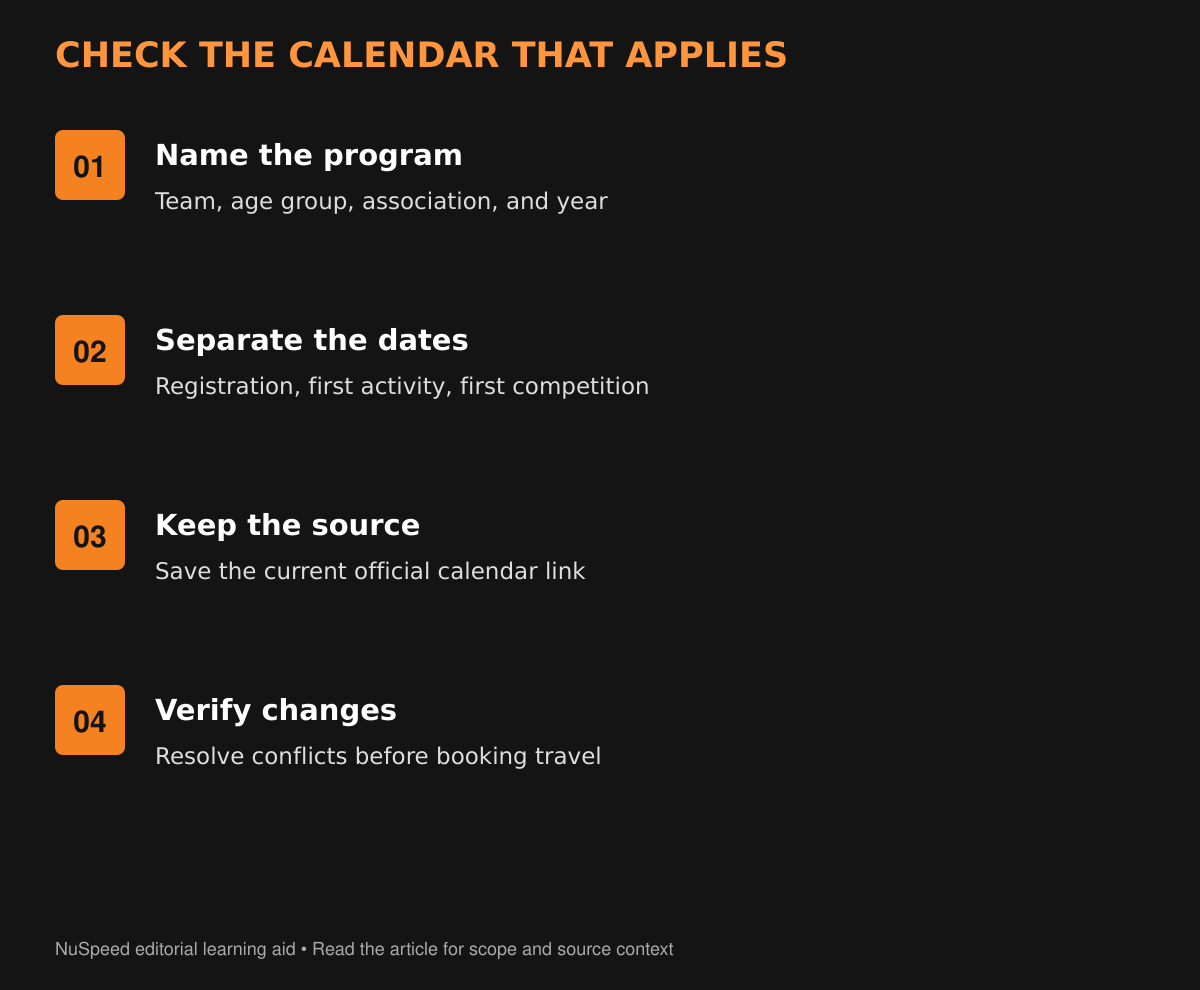
NuSpeed’s proposed family check: Write the program’s full name at the top of a calendar note. Add the age group or school team, the league or association, and the year. That sounds fussy until a search result returns last year’s schedule or a similarly named organization in another state.
Next, find the official source for three distinct dates: the administrative deadline, the first team activity, and the first competition. Registration closing, tryouts beginning, and games starting are separate events. A family can be ready for the opening game while already late for the paperwork.
Keep the source link next to the date. When somebody forwards a screenshot, the link helps answer whether it is the current version. If the league calendar and a team message differ, ask the organizer to resolve the discrepancy before paying for travel or assuming an athlete is available.
A shared calendar needs a little context
For a two-sport household, add the expected end of the first season and the start of the next one. Mark possible postseason dates as provisional rather than confirmed trips. Leave room for the athlete’s school events, family responsibilities, transportation, and downtime.
This is an organizing suggestion, not a ruling on whether two programs permit overlapping participation. Ask each program about its own expectations and governing rules. A coach’s enthusiasm for an athlete trying another sport does not automatically settle an association eligibility question.
Families can also separate fixed deadlines from dates they need to check again. An application deadline might be firm while a tournament location remains undecided. Treating both as equally settled is how a tentative listing becomes an expensive assumption.
What responsible seasonal coverage should do
NuSpeed’s editorial view: Local context belongs near the beginning of a sports story. A piece about preparing for playoffs should identify whose playoffs it means. A story about winter tryouts should name the program or region when the timing matters. Readers should not have to infer that a national headline is really describing one local calendar.
For this October, the most useful move may be a five-minute calendar check with the athlete. What is happening now? What deadline comes next? Who will verify any change? Let the answers set the plan.
A season feels different when a team is chasing a championship, choosing a roster, or waiting for its first practice. Good coverage can meet young athletes at each of those points without pretending they all share the same clock.
Find more practical youth-sports coverage at nuspeednetwork.com.
AI disclosure: AI assisted with research, drafting, and graphic development. This article awaits human editorial review and approval.
Sources