

A spectator’s guide to serving order, overlap and the rule differences that can make two legal plays look completely different.
AI-generated editorial illustration of a fictional scene. No actual athlete, team or event is depicted. Decorative maps, calendars and screens are conceptual, not factual records or instructions.
Imagine watching six volleyball players settle into what looks like a crowded knot. The serve crosses the net, and the knot opens: a setter heads toward the target, passers spread out and hitters start their approaches. A few moments later, everyone returns to another starting arrangement. From the bleachers, the movement can look like a puzzle with missing pieces.
The useful first question is which rules the match uses. An October school match, a club tournament and an international replay may operate under different codes. Learning the basic rotation pattern helps, but copying the timing of a televised team can lead a young player astray.
Start with the serving order
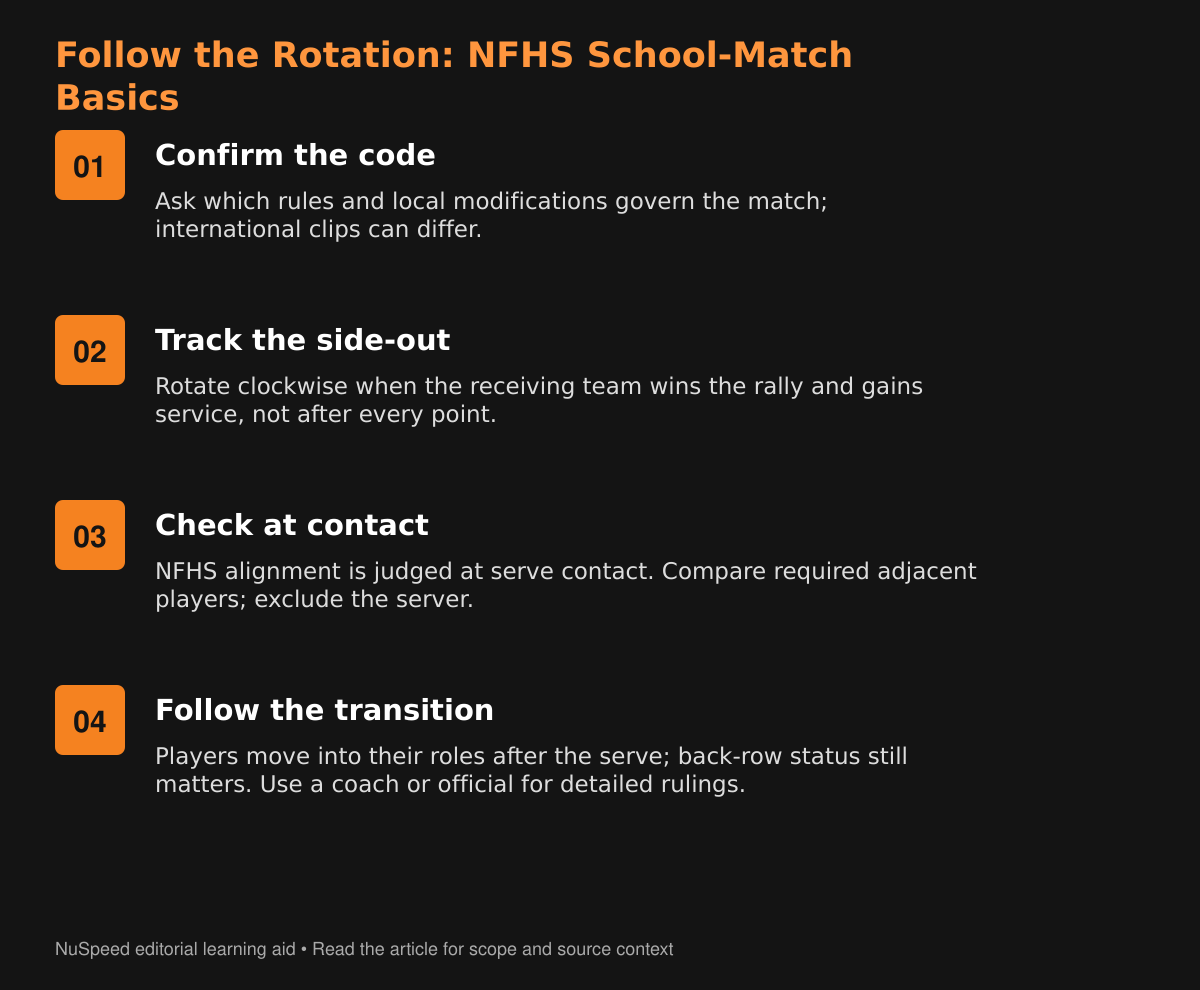
In standard six-player indoor volleyball, a receiving team rotates one position clockwise when it wins the rally and gains the serve. A team that wins another rally while already serving does not rotate again. The player moving from right front to right back becomes the next server. The familiar numbered map is front row 4–3–2 and back row 5–6–1, viewed from behind that team’s end line toward the net. These basics appear in USA Volleyball’s 2025–2027 indoor rulebook, Rules 7.4 and 7.6.
Think of that order as a sequence that travels around the court. A player’s usual job, such as setter, does not give that player a permanent place in the sequence. The team’s formation helps players reach the spaces where they will do their jobs once play develops.
For NFHS matches, watch serve contact
Under the NFHS alignment framework, both teams must maintain required relationships between adjacent players: left-to-right within each row, and corresponding front-to-back pairs. Officials judge alignment at serve contact using foot positions, excluding the server. The NFHS alignment interpretations distributed by the Massachusetts Interscholastic Athletic Association illustrate those distinctions.
Players can stand close together or move before the serve while preserving legal relationships at contact. Afterward, they transition into playing positions, but back-row status still matters. Be cautious about judging an overlap from someone’s shoulders or a poorly timed photograph.
Why the international replay looks different
The baseline FIVB 2025–2028 rules allow serving-team players to occupy any position at the service hit, while the receiving team must satisfy rotational order at that moment. USA Volleyball’s domestic modification in Rule 7.4 keeps the rotational-order requirement for both teams, excluding the server. Specific competition regulations can create exceptions, so the event’s rule set matters.
There is a further 2026 wrinkle. For the Volleyball Nations League, U17 World Championships and Continental Championships, FIVB announced an experimental receiving-team release: correct rotational order at the referee’s whistle, followed by freedom to move when the server’s first serving motion begins. That announcement is a test for named competitions. It does not change the NFHS school-match standard.
School volleyball does have a visible 2026–27 update: a team may designate two liberos, although only one can play at a time. NFHS also clarified that either libero may serve in the same single position in the serving order; using two does not create two libero service positions. See the current changes and 2026–27 interpretations.
A proposed five-minute viewing exercise
Choose one team and follow one complete turn through its serving order. Write down who serves, then mark each time the team gains service from its opponent. Leave tactical judgments aside. On a second viewing, follow one player from the legal starting arrangement into the rally.
This is a suggested learning activity, not an officiating test. For a disputed play, ask a coach or qualified official to explain the applicable rule after the match. Check state-association and event modifications before applying any diagram. Once the sequence becomes familiar, those shifting formations become easier to appreciate as coordinated teamwork.
Keep learning the games and the people behind them with NuSpeed Sports Whistle at nuspeednetwork.com.
AI disclosure: AI-assisted research and drafting. Sources checked October 3, 2026.
Sources
- USA Volleyball: 2025–2027 Indoor Rules Book
- MIAA: NFHS Boys Volleyball Alignment/Overlapping Interpretations, March 18, 2026
- FIVB: Official Volleyball Rules 2025–2028
- FIVB: Rule Tests for 2026 Competitions
- NFHS: Volleyball Rules Changes 2026–27
- NFHS: Volleyball Rules Interpretations 2026–27