

Finish place matters. Course context, race decisions and a runner’s own goals make the story more complete.
AI-generated editorial illustration of a fictional scene. No actual athlete, team or event is depicted. Decorative maps, calendars and screens are conceptual, not factual records or instructions.
Consider a hypothetical pair of race results. In one meet, a runner finishes 30th. In the next, that same runner finishes 45th. Has the runner gone backward? Without knowing the size and strength of the fields, the course or what happened during each race, the honest answer is that those two numbers cannot settle the question.
For programs racing in October, results can arrive faster than families have time to interpret them. A place, a finishing time and a team total each answer a different question. Our editorial view is that young runners deserve a conversation wide enough to include all three, along with the skills they are learning.
Read the result in its setting
Cross country uses varied terrain. World Athletics’ explanation of the discipline describes grass and woodland courses that may include gravel, roads and hills. A finishing time on one route therefore needs context before it is compared with a time elsewhere. Even a return to a familiar venue calls for checking the actual layout and conditions rather than assuming an identical test.
A practical comparison starts with plain details: date, course, listed distance, conditions and the official result. Note a changed route or a different competition field when that information is available. Avoid inventing a precise conversion between a muddy course and a dry one. A coach may have useful experience with both, but an estimate should remain an estimate.
That leaves room for an important sentence after a race: the result was slower, and we still need to understand it. Curiosity makes a better starting point than a verdict delivered beside the finish chute.
Remember how the team competition works
Under the standard NFHS scoring framework reproduced in the 2026–27 Kansas cross-country manual, the first five finishers’ places form a team’s score, with the lower total winning. Up to seven runners retain places that can affect opposing teams’ scores. State associations may use modified scoring, and meet-specific details must be checked. The runner outside the first five can therefore matter directly to a team result.
The scoring system also suggests a broader way to watch. Instead of concentrating only on the first athlete into view, follow the team through the field. Notice the contest around the later scoring places. Afterward, read the published team results rather than guessing a score from isolated finishes.
A proposed progress notebook
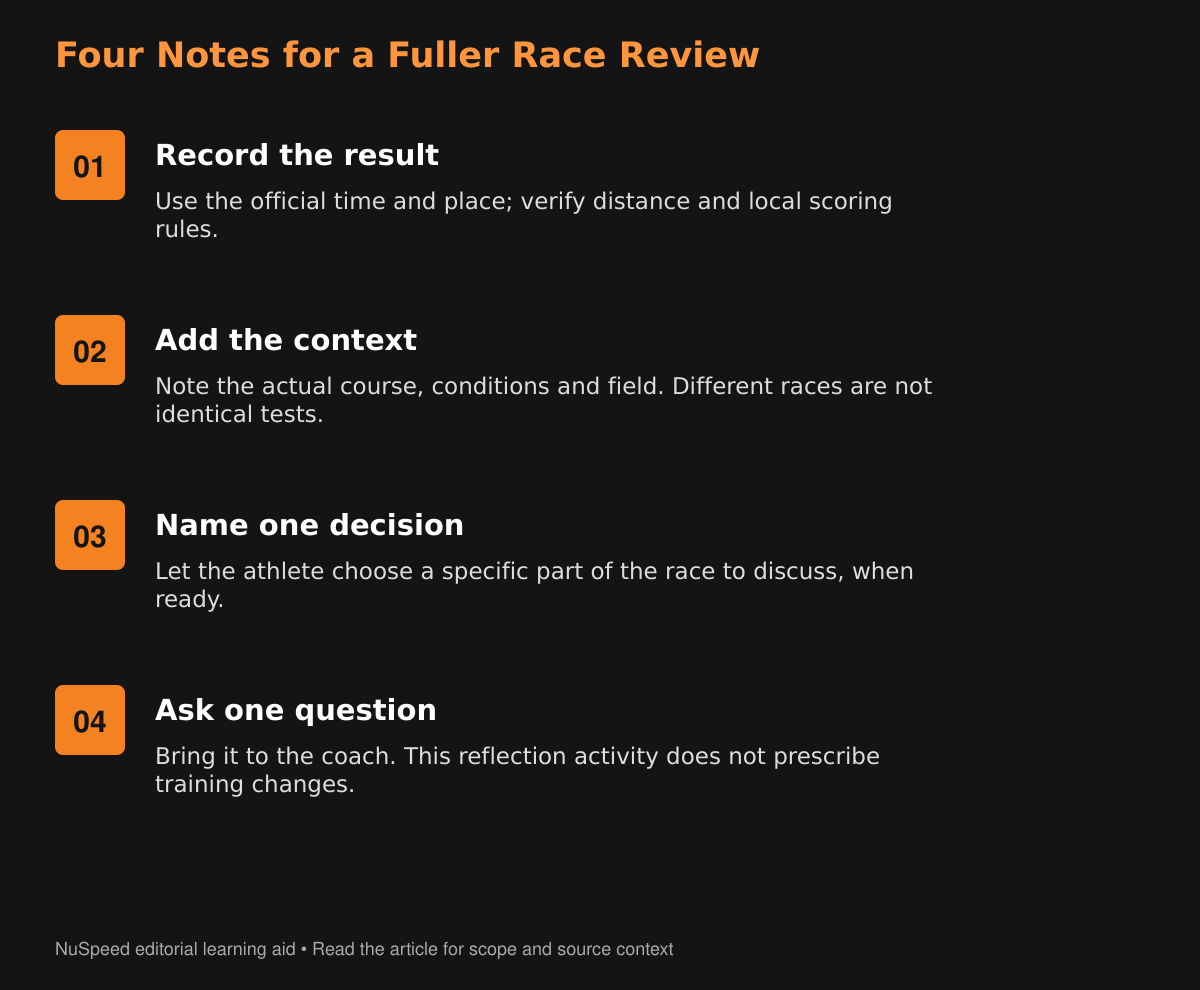
Here is a suggested reflection activity, not a training prescription. After the runner has had time to recover and is ready to talk, use four short entries: the official result; the race context; one decision the runner can describe; and one question for the coach.
The decision might involve following an agreed opening plan, responding to a crowded section or remembering a course turn. Keep the language specific. “I stayed with the plan through the first marker” gives a coach more to discuss than “I was good.” “I lost track of the route at the turn” identifies something to learn without labeling the whole race a failure.
Choose the observation with the athlete. A parent’s preferred milestone may not be the runner’s current priority. The NFHS discussion of transitioning to high-school track and cross country emphasizes communication, realistic intermediate goals and preparation. Those themes are useful without borrowing any one program’s workout schedule.
Keep the notebook small enough that it remains helpful. It should not become a second scoreboard or a demand to reveal every feeling. Do not turn one disappointing result into extra mileage or an improvised workout; training changes belong in a discussion with the coach, with health concerns directed to a qualified healthcare professional.
Let improvement have more than one shape
Our editorial recommendation is to celebrate observable steps without promising where they will lead. Learning the course, asking a clear question, understanding a team role and completing an agreed preparation routine are worth noticing. They can be recognized alongside a personal best, without pretending that every race went well.
Some days the athlete will simply be disappointed. There is no need to force a positive lesson on the walk back to the bus. Save the result, let the runner set the pace of the conversation and return to the details together. A season becomes easier to understand when each finish is treated as one piece of evidence in a much longer story.
Keep learning the games and the people behind them with NuSpeed Sports Whistle at nuspeednetwork.com.
AI disclosure: AI-assisted research and drafting. Sources checked October 3, 2026.
Sources
- World Athletics: Cross Country Running
- KSHSAA: 2026–27 Cross Country Manual, NFHS Scoring Framework
- NFHS: Transitions to a High School Track or Cross Country Program