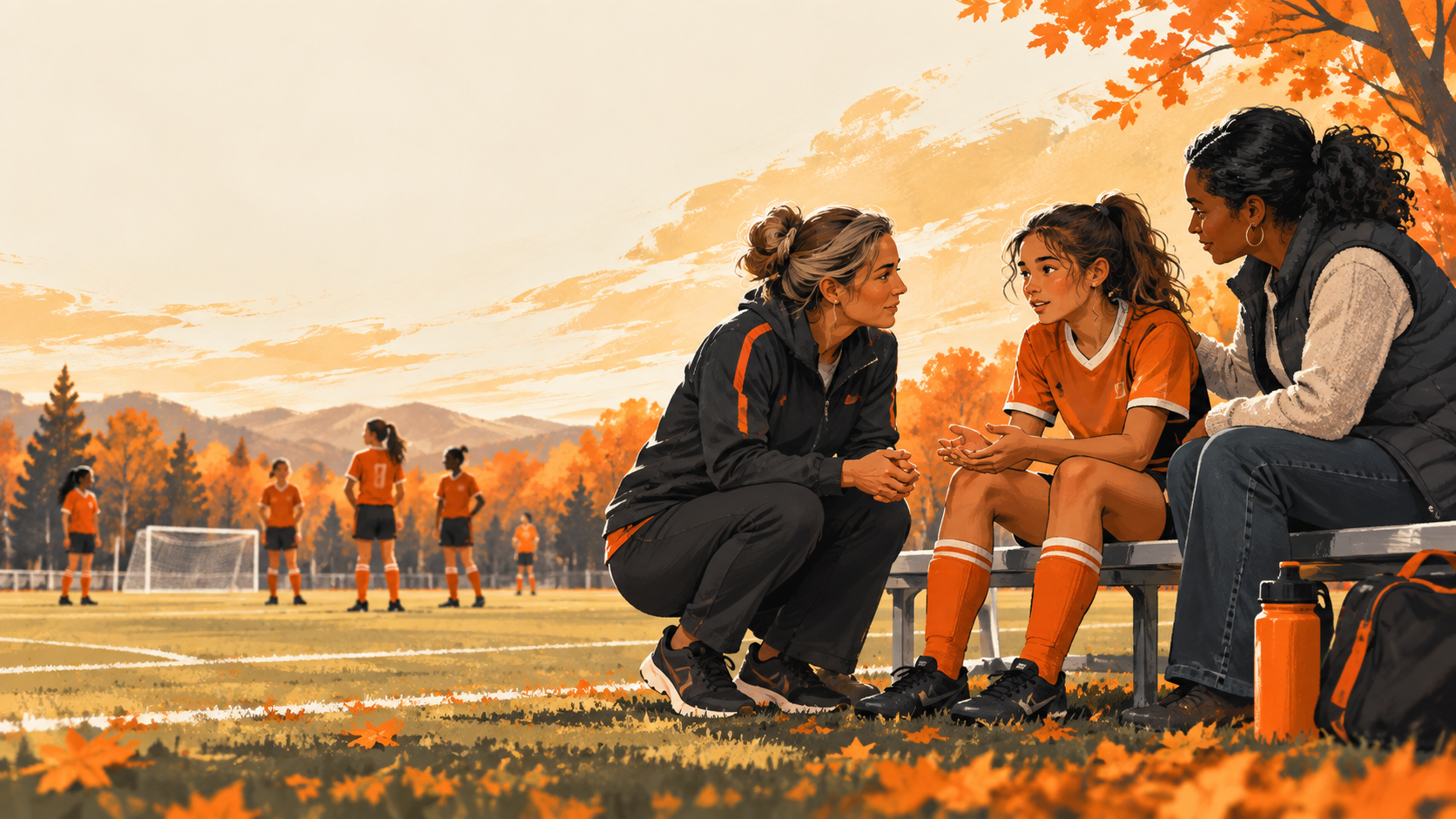

AI-generated editorial illustration; this does not depict an actual athlete or event.
A fall-sports guide to recognizing possible concussion symptoms—and building a team where young athletes can report them without shame.
Story transparency: The opening scene is fictional. Its characters, dialogue, and events are invented to illustrate a real issue; it is not an interview or account of an actual team.
Maya reaches the sideline and stays standing, hoping nobody notices that the field seems to tilt. A few minutes earlier, she collided with another player while chasing a loose ball. Now the noise feels louder. She wants to finish the match.
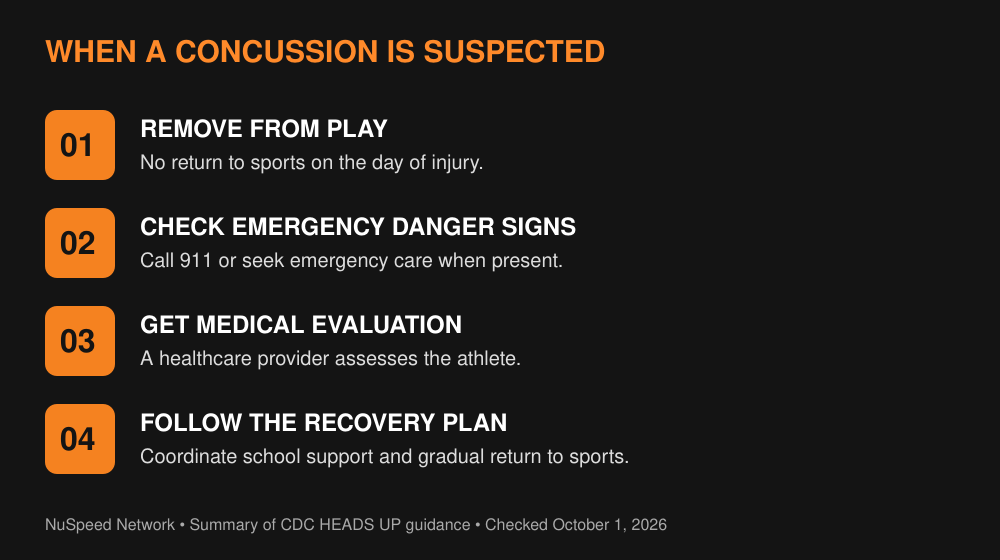
Her coach asks what she is feeling. Maya pauses, then says that she feels dizzy. The coach takes her out of the game, checks for emergency warning signs, and contacts her parent to arrange medical evaluation.
There is no celebration in the scene. Just a young athlete telling the truth and an adult treating that truth as more important than the scoreboard.
Recognize the concern; leave the diagnosis to a professional
CDC guidance says to remove an athlete immediately when a concussion is suspected after a bump, blow, or jolt to the head or a hit to the body. Keep the athlete out for the rest of that day and until a healthcare provider clears their return. Coaches and parents should not try to determine the severity themselves. [1]
Possible symptoms include headache, dizziness, balance problems, nausea, sensitivity to light or noise, and difficulty concentrating. Adults may notice confusion, slower answers, or unusual clumsiness. Symptoms can take hours or days to appear or be recognized. An athlete seeming fine immediately afterward does not settle the question. [2]
The point is not to turn every parent into a sideline clinician. It is to make the next action clear when there is a concern.
Know when it is an emergency
After a head injury, CDC advises calling 911 or going to an emergency department for danger signs such as seizures, repeated vomiting, increasing confusion, inability to wake or stay awake, slurred speech, weakness, a worsening headache that does not go away, or unequal pupils or double vision. This is not an exhaustive list; the linked CDC resource provides the full warning signs. [2]
Recovery includes the classroom
The conversation should continue beyond the sideline. CDC says most children can return to school within one to two days, sometimes with symptoms and tailored support. Families should work with the healthcare provider and school on a plan. Extra assignment time, rest breaks, or a quieter learning space are examples of accommodations—not a universal prescription. [3]
Being back in class does not automatically mean an athlete is ready for competition. CDC describes a six-step return-to-sports progression under healthcare-provider approval and supervision. Each step typically takes at least 24 hours. New or returning symptoms mean stopping the activity and contacting the medical provider. The progression is individualized, not a guaranteed six-day countdown. [4]
NuSpeed’s view: make honesty part of the team culture
This is our editorial position: reporting a symptom should earn an athlete respect. A child should not have to choose between being believed and being considered committed.
Coaches can explain the reporting process before a game. Parents can ask who handles an injury concern. Teammates can practice responding with support rather than teasing. These are proposed team practices, not claims that a particular script has been proven to prevent injury.
In our fictional scene, Maya’s coach could tell the team: “Speaking up helps us look after each other.” The words matter less than the behavior that follows. The athlete remains part of the team while the adults follow the medical plan.
A useful conversation before the next game
- Who should an athlete tell when something feels wrong?
- Who contacts the family and arranges medical evaluation?
- Who coordinates school support and the provider’s return-to-sports instructions?
Save the CDC resources below and discuss those questions with your team. A well-played season should include adults who listen when an athlete needs help.
AI disclosure: AI was used to assist with research, drafting, and illustration development for this content. Linked source pages were checked during draft preparation. NuSpeed’s publisher reviewed and approved this article before publication.
Health information is general education. Diagnosis and return-to-sports decisions belong to a qualified healthcare provider.
Sources
- CDC: Responding to a Sports-related Concussion — updated September 15, 2025.
- CDC: Signs and Symptoms of Concussion — updated September 15, 2025.
- CDC: Returning to School After a Concussion — updated August 6, 2025.
- CDC: Returning to Sports — updated September 15, 2025.
All four pages opened and checked October 1, 2026. These are public-health guidance sources, not original studies independently reviewed for this draft.