

A practical communication plan can help tennis partners understand the next point, especially when they are learning to play together.
AI-generated editorial illustration of a fictional scene. No actual athlete, team or event is depicted. Decorative maps, calendars and screens are conceptual, not factual records or instructions.
A doubles partnership asks two players to make decisions in the same small stretch of time. Who takes the ball through the middle? What does the server intend to do? Does a quiet partner want encouragement, a tactical suggestion, or a moment to reset? Players cannot solve every uncertainty before a match, but they can agree on how to talk about it.
The useful starting point is modest: give each other information that can be acted on. A running commentary on mistakes does little to explain the next assignment. For a new pairing, even a short conversation before stepping on court can reveal assumptions that otherwise stay hidden until an important point.
Agree on the basics before adding signals
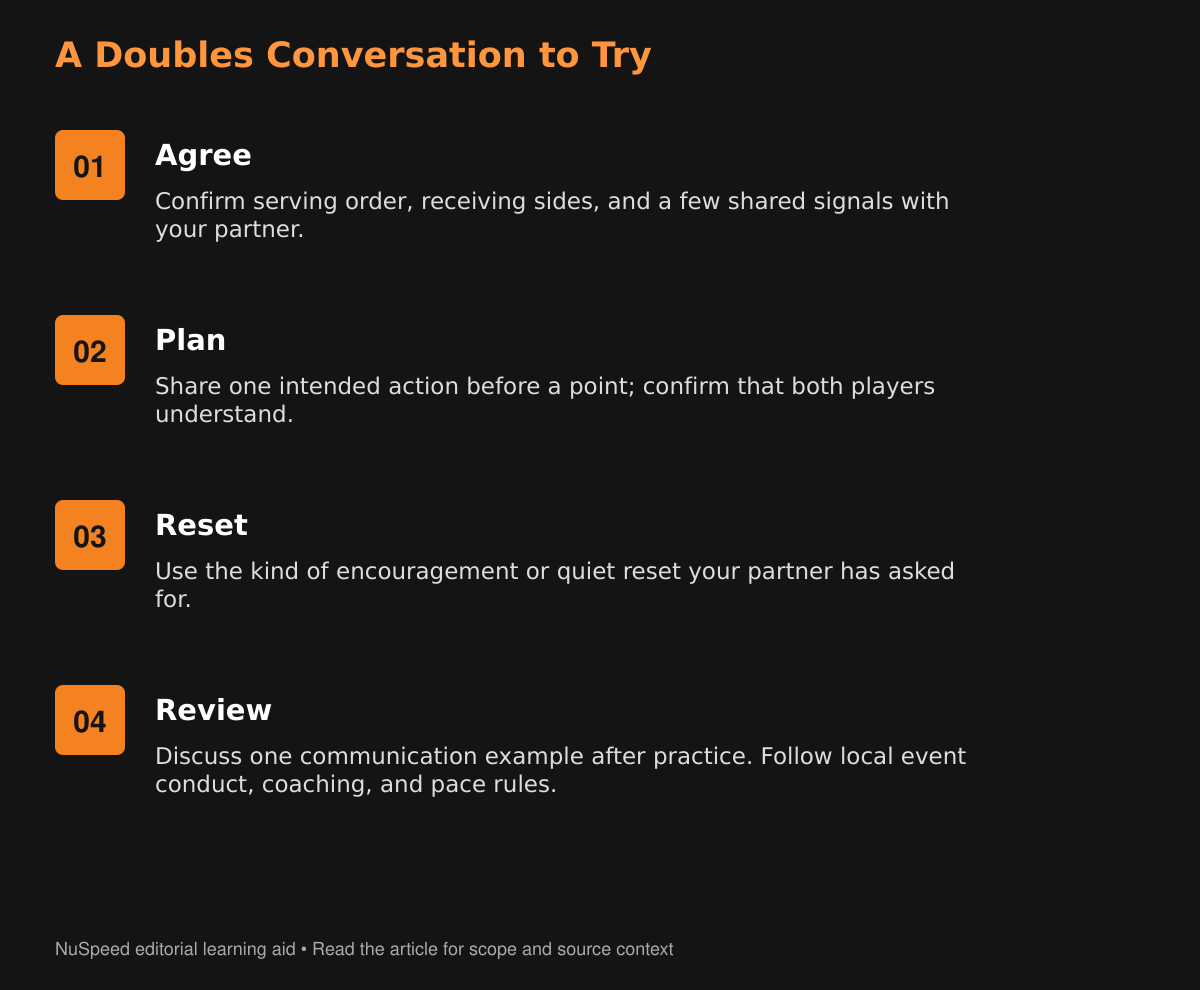
Begin with the match format, serving order, receiving sides, and any questions about the event rules. The USTA doubles guide explains that partners keep their receiving sides for the set and may change them for the following set. The designated receiver returns the serve. After that return, either partner may play subsequent shots in the rally; partners do not have to alternate. Those basics make communication part of the partnership rather than an optional extra.
A complicated system of hand signals is unnecessary if neither player knows what the signals mean. Choose a small vocabulary together, rehearse it in practice, and ask the coach how it fits the pair’s positioning. A signal that one player cannot reliably see is not an agreement yet. Discuss an accessible alternative instead of assuming that every pair should communicate identically.
Share a plan rather than a prediction
In a USTA Texas interview about new doubles partners, mental performance consultant Brandi Bratek recommends discussing strengths and difficult shots before a match and communicating intentions at the start of a point. The distinction matters: a player can describe an intended serve or movement without promising perfect execution.
Editorial guidance: Our proposed approach is to choose one useful detail at a time. The server can explain the intended target; the partner can confirm the planned movement. Both players should be able to repeat the basic plan. If the exchange produces three different tactical changes, save the longer discussion for an appropriate break and simplify the immediate task.
Practicing that exchange should include what happens when the intended shot does not arrive. Ask a coach to help the pair rehearse realistic alternatives. This article does not prescribe positioning for every level or situation; the goal is to make the players’ understanding visible enough for a coach to teach it.
Decide what support actually sounds like
Partners can have different preferences after a missed shot. One may appreciate a brief acknowledgment, while another dislikes hearing reassurance repeated after every error. Ask ahead of time what feels helpful. A preference can change during a match, so leave room for a simple adjustment without turning the discussion into a judgment about toughness.
A useful agreement might cover when to offer tactical advice, how to request a quieter reset, and how to flag confusion. These are proposed conversation topics, not required scripts. Avoid assigning motives to a facial expression. If a partner seems frustrated, ask at the next appropriate opportunity rather than announcing that they have stopped trying.
Keep the review small enough to use
After practice, choose one communication exchange to examine. What information was missing? Did both players understand the same word? Could the message have arrived earlier? Describe what happened without reducing a person to the mistake. A note about unclear responsibility is more useful for the next session than a list of who lost each point.
Respect the event’s pace-of-play and conduct rules throughout. Between-point planning is not permission to delay play, distract opponents, or assume that outside coaching is allowed. Ask the event staff or coach about the rules that apply to that competition.
Tennis is played on different school and league calendars, so this conversation belongs wherever a local partnership is beginning or being refreshed. Our editorial view is that a good first target is simple: both players leave the discussion knowing what their partner means, how to ask for clarification, and what they will try together next time.
Continue the conversation: Visit nuspeednetwork.com for NuSpeed Sports Whistle.
AI disclosure: This draft was prepared with AI assistance. Sources were checked October 3, 2026. Human editorial review and approval are pending. Do not publish or schedule this draft.
Sources