
Use the clock alongside skills, race understanding, and the athlete’s own observations as the local swimming season develops.
AI-generated editorial illustration of a fictional scene. No actual athlete, team or event is depicted. Decorative maps, calendars and screens are conceptual, not factual records or instructions.
Swimming gives families an unusually precise result. A time appears, and the comparison with a previous swim can happen almost immediately. That precision is useful, but the conversation after a meet can include more than whether the number became smaller. A swimmer may be learning a race plan, applying a technical correction, or approaching an unfamiliar event with greater understanding.
Local calendars vary. School, club, and community programs may be starting, building toward a meet, or closing a season at different times. Families should use their own team’s schedule and the coach’s stated goals rather than assume that a month on the calendar means the same phase of training everywhere. This guide is intended for a local meet cycle whenever it occurs.
Begin with the right comparison
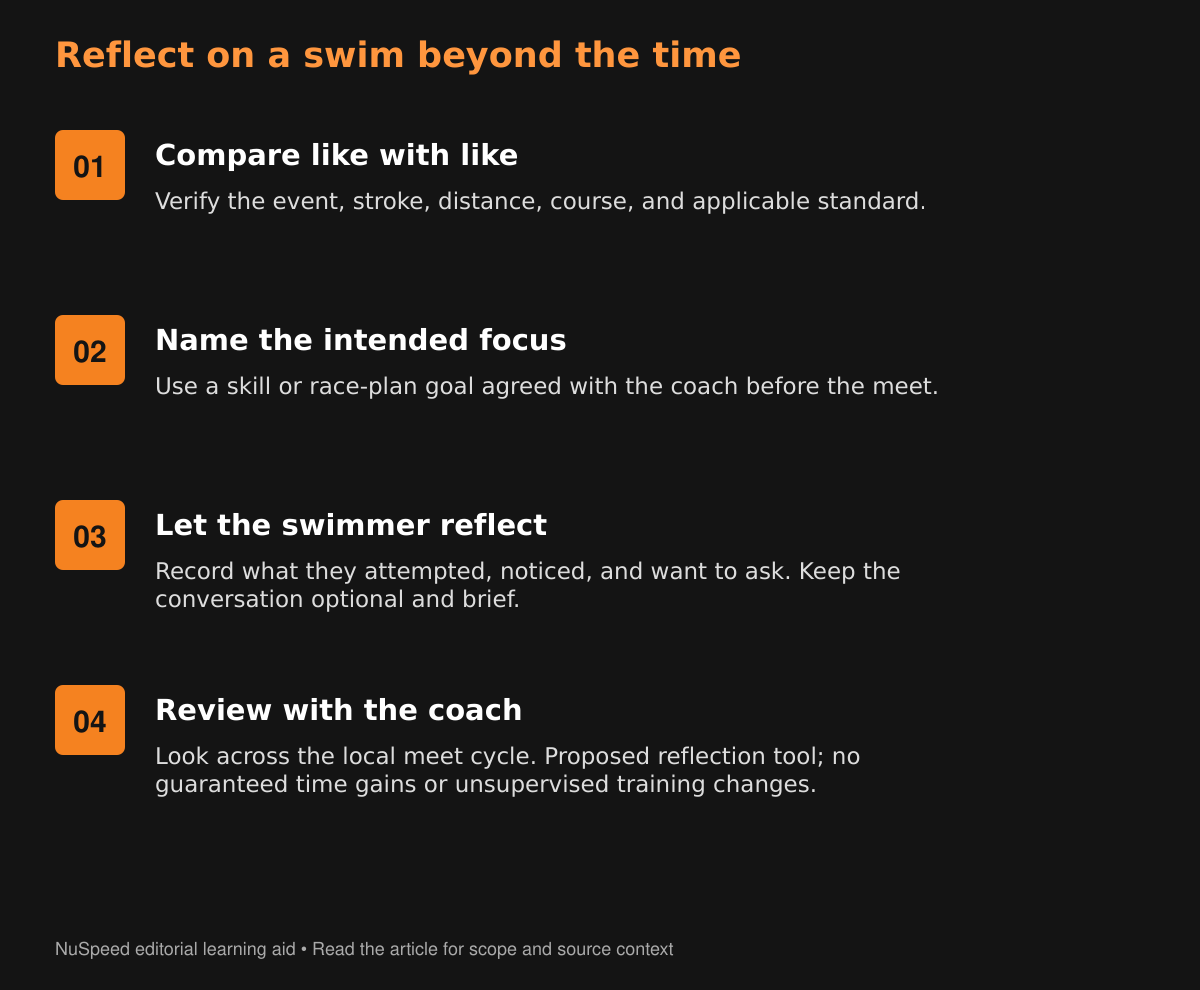
Check that the performances being compared belong together. Event, distance, stroke, course, and relevant age category matter when reading standards or results. USA Swimming publishes separate time-standard documents for different competition contexts and course formats. Confirm which standard actually applies to the meet instead of treating an online chart as universal. Source: USA Swimming time standards.
Even with the appropriate comparison, one result cannot describe everything the athlete practiced. Our editorial recommendation is to ask the swimmer and coach what the race was intended to test. A focus chosen before the meet makes the post-race discussion more concrete. It also avoids inventing a success criterion afterward merely because the time was disappointing.
A hypothetical example: the coach and swimmer agree to concentrate on a particular turn detail. After the race, they can review whether that detail appeared and what still needs work. The time remains part of the result. The example simply creates another question that can be answered. It is an illustration of a conversation, not a report about a real athlete or a promise that a technique change will produce a faster swim.
Give development a wider vocabulary
USA Swimming’s American Development Model is designed to support long-term athlete development and evaluation. It includes sport skills, training habits, and development across stages, giving coaches a broader structure than a single finishing time. Families can ask how the coach uses an appropriate development approach for their swimmer. Source: USA Swimming American Development Model.
Our proposed discussion tool has three short entries: what the swimmer attempted, what they noticed, and what they want to ask the coach. It is an editorial reflection aid, not a validated assessment or an extra training assignment. Use the athlete’s words. A parent who fills in every answer can unintentionally turn reflection into another performance test.
Make the entries specific enough to be useful. Understanding where a race plan became difficult gives a coach more to discuss than a broad label such as bad meet. Equally, a swimmer may be proud of completing a first event or remembering a pre-race responsibility. Whether those are appropriate goals depends on experience and the program, so let the coach and athlete establish the relevant expectations.
Let the post-meet conversation breathe
Ask whether the swimmer wants to talk now or later. A family can celebrate effort and companionship without conducting a technical review in the parking lot. When the athlete does want to discuss the race, start with their observation before offering yours. A parent’s poolside view may miss details that the swimmer or coach experienced more directly.
Avoid attaching a broad identity to a single result. Describing a swim as slower than a previous performance is different from deciding the swimmer has stopped improving. Likewise, a personal best need not become a demand that the next meet produce another. Our editorial view is that specific observations make it easier to enjoy achievements while leaving room for continued learning.
Over several meets, review the notes with the athlete’s permission and keep the process light. Look for questions worth bringing to the coach, such as whether a repeated challenge needs a clearer explanation. Do not add unsupervised drills or change a training plan based on a family tracking sheet. Technical preparation belongs with qualified coaching.
The clock will always have an important place in competitive swimming. Families can give it context by noticing what the athlete is learning and by supporting an honest conversation about the next step. A useful season record can hold both the best time and the developing swimmer behind it.
For more practical youth-sports coverage, visit NuSpeed Network at nuspeednetwork.com.
AI disclosure: This draft was created with AI assistance using the linked sources. It is pending human editorial review and approval before scheduling or publication.
Sources