

Contact limits depend on the governing organization, age group, season phase, and definition. A clear answer starts with the actual written policy.
AI-generated editorial illustration of a fictional scene. No actual athlete, team or event is depicted. Decorative maps, calendars and screens are conceptual, not factual records or instructions.
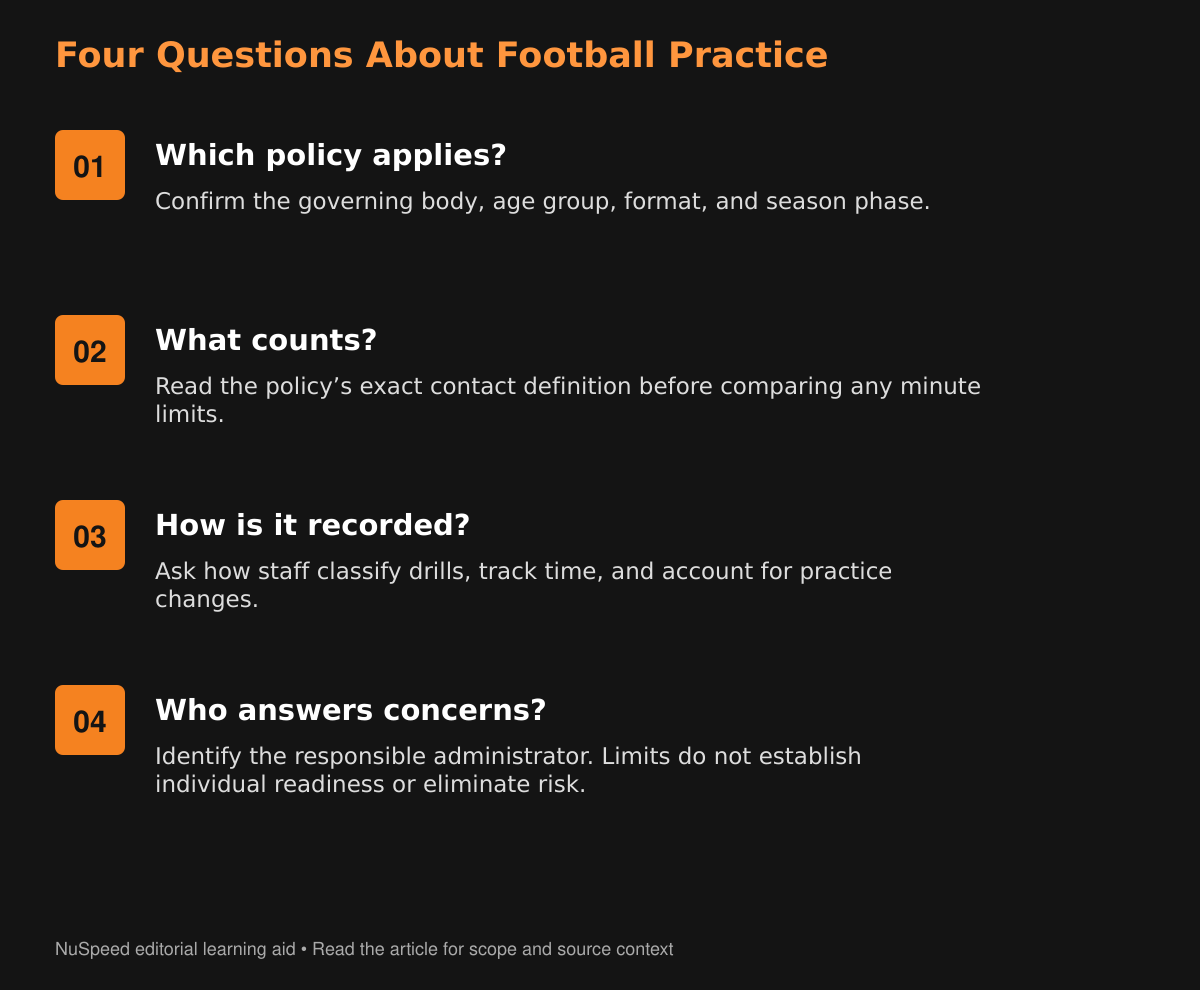
“We limit contact” is a starting point for a conversation, not a complete description of football practice. A family still needs to know what counts as contact, which policy governs the team, how time is recorded, and what happens when the practice plan changes. Those questions are reasonable at the beginning of a season and whenever the answers are unclear.
A number taken from another league can create more confusion than confidence. Youth tackle recommendations, high school association rules, and flag or limited-contact formats do not automatically share the same scope. Even the phrase full contact can be defined differently. Start with the team’s governing document, not a screenshot of a minute limit.
Identify the policy and who it covers
Ask the program to provide the current written practice policy and identify the governing organization. Confirm the player’s age division, game format, and season phase. Ask whether the document is a recommendation the program has adopted, a binding league rule, a school association requirement, or part of a stricter local policy.
As one youth example, USA Football’s published recommendations for youth play advise, after acclimatization, no more than 75 minutes of full contact per week during preseason and 60 during the regular season, with no more than 30 on one day. The document defines full contact by competitive-speed player-to-player contact, whether or not a player goes to the ground. It also recommends avoiding full-contact practices on consecutive days, including the day after a game or live-action scrimmage.
These are the source’s recommendations, not a claim that every youth league follows them or that they establish an appropriate individual workload. The document describes its updated guidelines as dating to 2021; it was checked for this article on October 3, 2026. Confirm what the local program has actually adopted.
Check the definition before comparing numbers
A school example shows why definitions matter. The Texas UIL fall practice regulations cap full-contact practice at 90 minutes per week in preseason, regular season, and postseason. That page defines full contact as competitive full-speed drills or live simulations in which players are taken to the ground. It separately describes an initial five-day acclimatization period. These requirements apply within the UIL framework, not to every football team in Texas or elsewhere.
The USA Football and UIL numbers therefore should not be lined up as equivalent measurements. Their full-contact definitions differ, and they govern different settings. A practice period excluded from one category may still matter under another rule. Families should ask the local administrator to explain the full policy rather than decide compliance from one number.
Ask how the plan becomes a record
Proposed family discussion tool: Request an explanation of how staff classify drills, track contact time, and account for scrimmages or players moving between squads. Who maintains the record? Who checks it? How are substitutions or changes to the planned session handled? These are operational questions, not an invitation for spectators to make contact classifications from the fence.
A useful response can describe the process in ordinary language and point to the relevant policy section. If different staff members give different answers, ask the program administrator to reconcile them in writing. Do not assume that a short practice or a particular equipment choice answers every question about what happened during it.
Ask how concerns can be raised during the season, too. Families should know the designated contact for a possible policy violation and the route for immediate medical concerns. A disagreement about a weekly total should not delay getting appropriate help for an athlete who is injured or unwell.
Understand what a limit cannot tell you
Compliance with a contact limit does not establish that a practice is risk-free or that a particular athlete is ready to participate. This article does not claim safer outcomes from any listed number, compare injury rates, or prescribe drills, equipment, or return-to-play decisions. Qualified program staff and healthcare professionals have responsibilities that a general checklist cannot replace.
Our editorial recommendation is to keep four items together: the governing document, its contact definition, the program’s tracking explanation, and the name of the person who handles questions. Verify them for the local calendar and current season. The strongest answer to a family is one they can understand, locate, and revisit when the plan changes.
Continue the conversation: Visit nuspeednetwork.com for NuSpeed Sports Whistle.
AI disclosure: This draft was prepared with AI assistance. Sources were checked October 3, 2026. Human editorial review and approval are pending. Do not publish or schedule this draft.
Sources
- USA Football: Recommendations for Youth Play
- Texas UIL: Fall Football Practice Regulations
- Texas UIL: Football Rules and Guidelines