
Useful messages, appropriate adult visibility, and careful handling of photos can make team communication easier to understand and manage.
AI-generated editorial illustration of a fictional scene. No actual athlete, team or event is depicted. Decorative maps, calendars and screens are conceptual, not factual records or instructions.
A team chat can solve a small logistical problem quickly: a changed field, a delayed arrival, a missing equipment reminder. It can also become the place where private information, late-night demands, and unclear expectations accumulate. The best time to decide how the chat works is before the first difficult message appears.
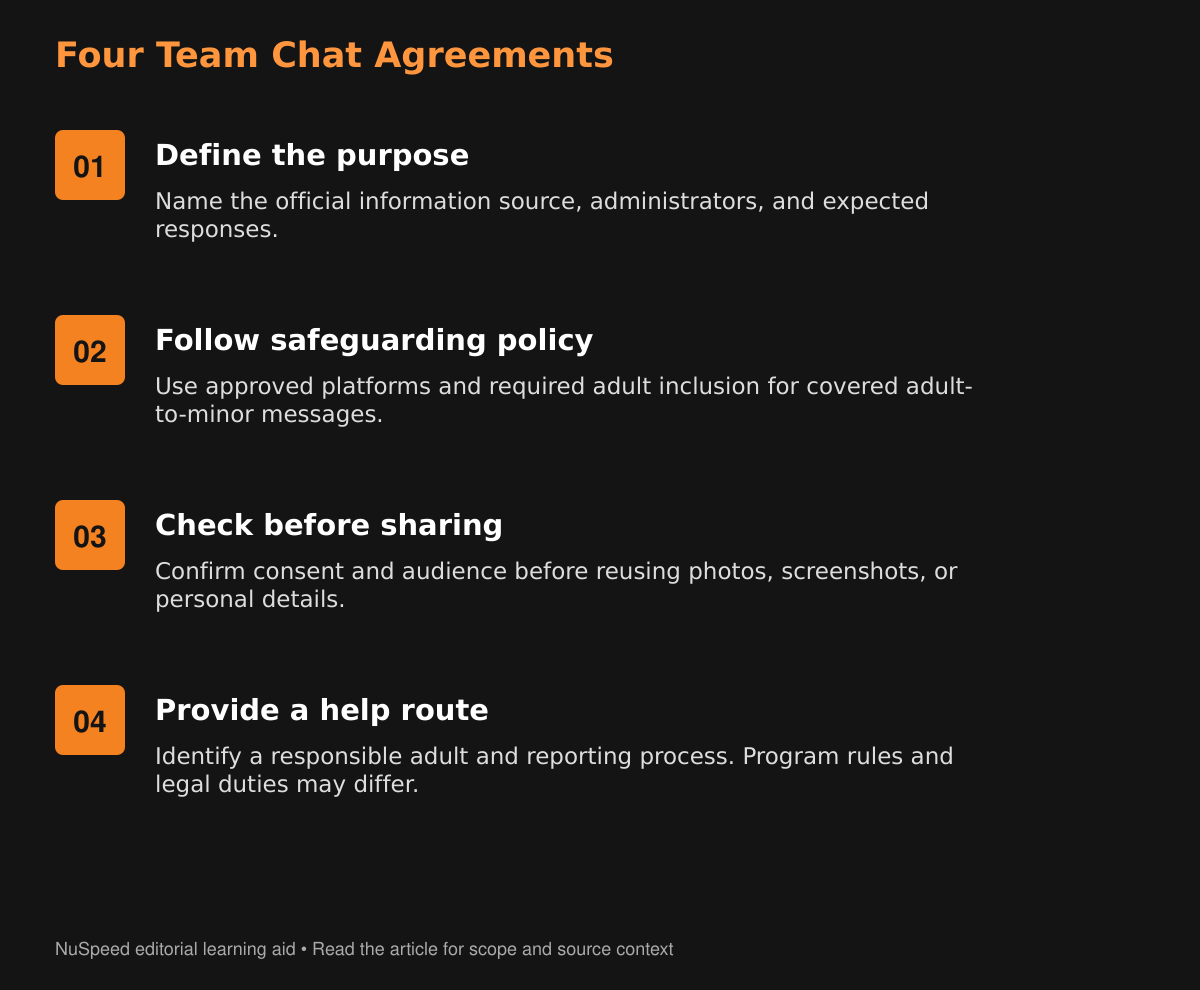
Start by naming its purpose. Is it for official scheduling, parent coordination, athlete discussion, or announcements only? Those are different functions, and mixing them can make it hard to know which information is authoritative. A team should be able to explain where the official schedule lives and which messages require a response.
Know the safeguarding rules that apply
The U.S. Center for SafeSport’s 2025 Minor Athlete Abuse Prevention Policies, known as MAAPP, establish minimum requirements within the U.S. Olympic and Paralympic Movement. Sport-specific policies may add requirements. This is not a statement that every independent school team or community chat falls under the same policy; confirm the program’s governing rules.
The Center’s electronic communication guidance explains that covered adult-to-minor communications must be open and transparent unless an exception applies. Appropriate adult inclusion remains relevant when a minor initiates the exchange and when an adult messages a team. A group containing several young athletes is not, by itself, the same as including the required adult.
Do not improvise exceptions from a general article. Ask the designated program administrator which approved platform, adult participants, communication hours, and escalation procedures the organization requires. An adult athlete, volunteer, or other team member may also have responsibilities under the applicable policy.
Write down a few usable expectations
Proposed team tool: Create a short chat agreement covering purpose, administrators, response expectations, and the route for urgent changes. Specify which messages need acknowledgment and which are simply informational. Avoid treating an immediate reply at any hour as proof of commitment.
Agree on an ordinary communication window consistent with program policy, then explain how genuinely urgent logistics will be handled. A weather cancellation and a routine equipment reminder do not need the same notification pattern. Families should also know how to receive essential information if the app, device, or data connection is inaccessible to them.
Keep playing-time disagreements, criticism of individuals, and sensitive personal details out of the general group. Route those matters to the appropriate staff through an approved channel that still follows safeguarding requirements. Moving a concern out of public view should never mean moving it into an unauthorized private adult-to-minor exchange.
Ask before sharing beyond the intended audience
A photo sent to a team group should not automatically become a public social post. Our editorial recommendation is to confirm the program’s consent process, the proposed audience, and any limits before reusing a participant’s image or information. Respect an athlete’s expressed discomfort and involve the appropriate guardian and staff for minors.
Be careful with screenshots, too. A message about an absence may reveal more than a family intended. Names, phone numbers, location details, and visible notifications can travel with an image. Share only what the recipient needs, through an authorized route, and avoid making private conversations part of a public dispute.
Do not use the chat as a medical record, a public discipline log, or a place to speculate about another family. If information is needed for participation, use the organization’s designated process. This article offers editorial planning guidance, not legal advice about privacy, consent, reporting duties, or records retention.
Explain what happens when a boundary is crossed
A useful agreement names the person who can respond to a concern and describes the reporting route. Young athletes should know they can ask a trusted adult for help with an uncomfortable message. They should not be assigned responsibility for enforcing adults’ behavior.
If a message suggests abuse or another serious concern, follow the applicable reporting requirements and seek appropriate help. Do not circulate sensitive content widely or rely on a group argument to resolve it. An immediate emergency needs immediate assistance, not a delayed reply in an app.
Review membership and administrator access when rosters change, and follow the organization’s retention rules before removing records. Our editorial view is that a successful team chat should be easy to explain: people know why they are included, what information belongs there, when they are expected to respond, and where to go when something feels wrong.
Continue the conversation: Visit nuspeednetwork.com for NuSpeed Sports Whistle.
AI disclosure: This draft was prepared with AI assistance. Sources were checked October 3, 2026. Human editorial review and approval are pending. Do not publish or schedule this draft.
Sources
- U.S. Center for SafeSport: 2025 Minor Athlete Abuse Prevention Policies
- U.S. Center for SafeSport: How to Safely Communicate with Minor Athletes