

A spectator’s guide to the two-part decision, the common exceptions, and the viewing habit that makes a fast game easier to follow.
AI-generated editorial illustration of a fictional scene. No actual athlete, team or event is depicted. Decorative maps, calendars and screens are conceptual, not factual records or instructions.
The forward collects the ball with open grass ahead and only one opponent nearby. That picture alone cannot tell a spectator whether the play is offside. The decision depends on an earlier moment and on what the attacker does next. For families learning the game during their local soccer season, that small change in where to look can make a confusing whistle much easier to understand.
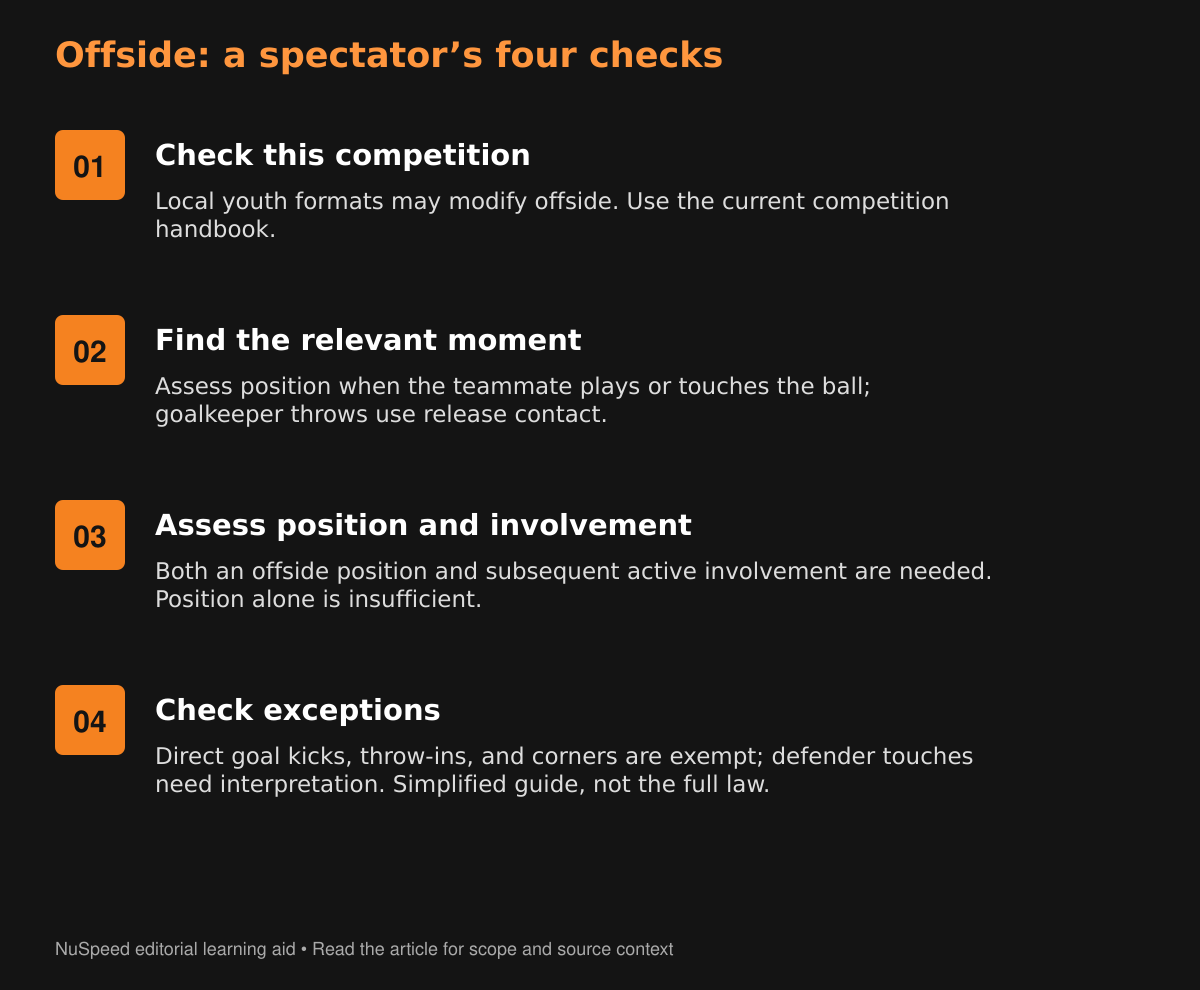
Begin with two questions: where was the attacker when a teammate played or touched the ball, and did the attacker subsequently become involved in active play? Position and involvement work together. A player can occupy an offside position without committing an offense. Source: IFAB Law 11.
Build the picture at the pass
Under the standard law, an offside position requires a relevant part of the player’s head, body, or feet to be in the opponents’ half and nearer the goal line than both the ball and the second-last opponent. Arms and hands do not count. Being level with the second-last opponent or with the ball is onside. The halfway line itself does not put a player in the opponents’ half. Source: IFAB’s plain-language Football Rules explanation.
Notice the word opponent. The goalkeeper often happens to be the last opponent, but the law does not require that arrangement. Counting shirts in defensive positions without locating the goalkeeper can therefore produce the wrong picture. For the moment of the teammate’s play or touch, the first point of contact is used; when a goalkeeper throws the ball, the last point of contact is used instead. Source: IFAB Law 11.
Then ask what the player did
Active involvement can include playing the ball or interfering with an opponent, such as clearly blocking the opponent’s view of the ball or challenging for it. A spectator who watches only for a touch can miss why an offense was given. Conversely, an attacker standing beyond the line does not automatically invalidate everything teammates do elsewhere. The relevant question is involvement under the law. Source: IFAB Football Rules.
The familiar exceptions are worth learning carefully: a player cannot commit an offside offense by receiving the ball directly from a goal kick, throw-in, or corner kick. The word directly matters. Once another teammate plays or touches the ball, a new offside assessment may arise. Source: IFAB Law 11.
A defender’s touch also needs interpretation. IFAB distinguishes a controlled opportunity to play the ball from a deflection. An unsuccessful pass or clearance can still be deliberate play; an instinctive stretch producing limited contact can be a deflection. A deliberate save is treated separately and does not automatically remove an attacker’s offside restriction. Simply seeing a defender touch the ball is insufficient. Source: IFAB clarification on deliberate play.
A better spectator habit
Our editorial suggestion is to practice watching a few possessions without trying to decide every call. Locate the passer, glance across the attacking line, and then follow the receiving player. It is an attention exercise, not a referee-training method. The ball naturally pulls the eye forward, so a viewer can easily remember the positions at reception more clearly than the positions at the pass.
A seat at an angle also limits what can be judged confidently. Rather than treating uncertainty as evidence of a mistake, leave room for the official’s position and the part of the play you did not see. A useful question after a match is which part of the law applied. Shouting a conclusion from the touchline rarely supplies the missing information.
Finally, check the competition’s own rules. Younger small-sided games can modify how offside is applied. U.S. Soccer’s development guidance describes using the build-out line in the relevant 7v7 format; that historical guidance does not replace today’s local competition rules. Source: U.S. Soccer small-sided standards explainer. Read the current handbook before assuming the professional version governs every youth match.
For more practical youth-sports coverage, visit NuSpeed Network at nuspeednetwork.com.
AI disclosure: This draft was created with AI assistance using the linked sources. It is pending human editorial review and approval before scheduling or publication.
Sources
- IFAB Law 11: Offside
- IFAB Football Rules: Offside
- IFAB: Deliberate play guidelines clarified
- U.S. Soccer: How Small-Sided Standards Will Change Youth Soccer