

A realistic in-season plan starts with the hours a student actually has.
AI-generated editorial illustration of a fictional scene. No actual athlete, team or event is depicted. Decorative maps, calendars and screens are conceptual, not factual records or instructions.
A late bus ride is easy to write into a schedule as study time. It is harder to complete an assignment there when the ride is noisy, the connection is unreliable, or the student needs a book left at home. Planning works better when it describes real conditions instead of filling every empty box with homework.
In a busy competition week, young athletes and their adults can begin with a plain question: what work requires a desk, what can travel, and what needs a conversation before the deadline? Those distinctions make the calendar more honest.
There is no universal system that fits every student. The suggestions below are an editorial planning tool for families to adapt with teachers and coaches, not a promise of higher grades or a substitute for school support.
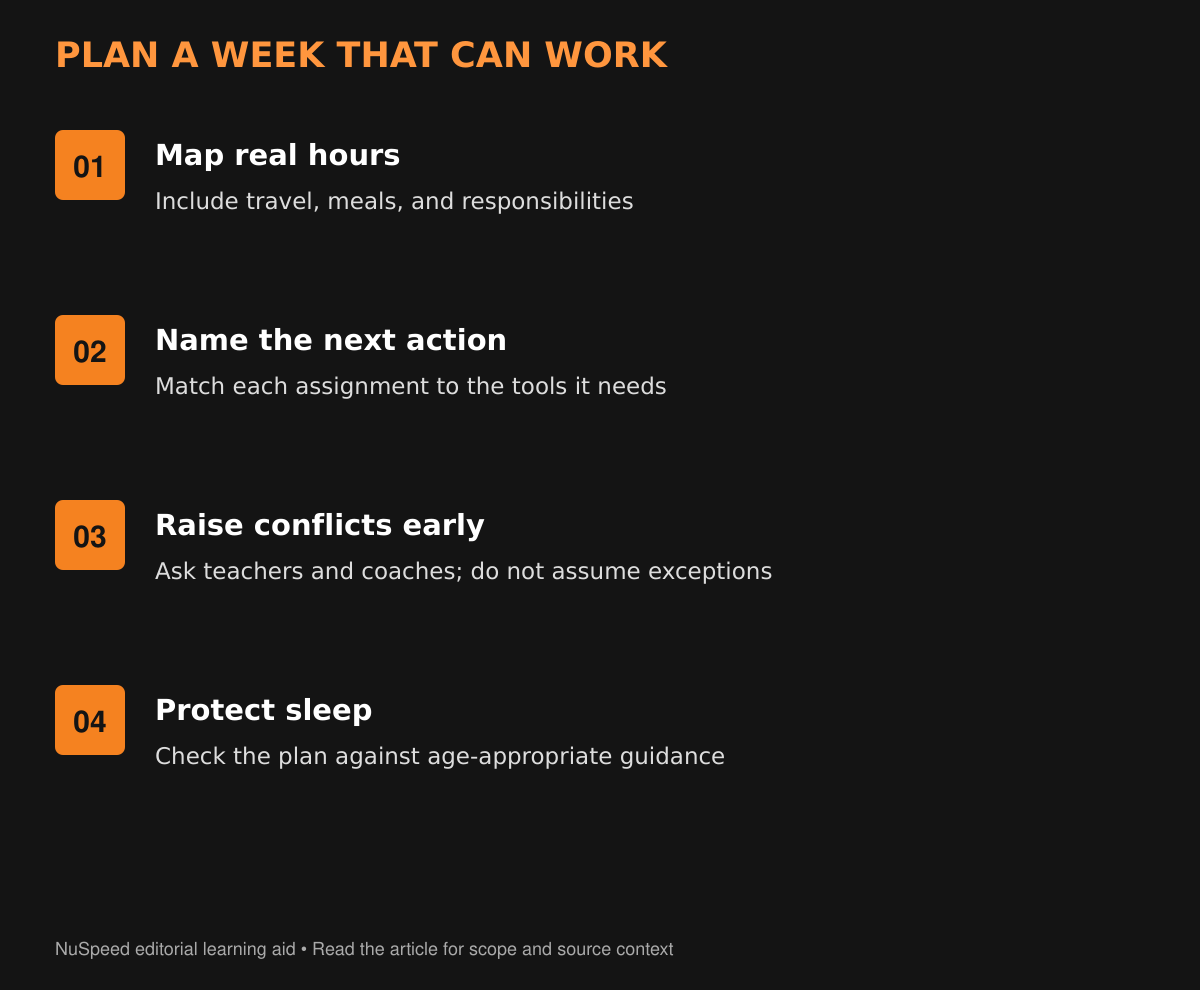
Map the week before dividing the assignments
Put school hours, practices, games, travel, meals, and existing responsibilities on one page. Use the actual expected return time, not the final whistle. A competition ending at eight does not mean a student is ready to work at eight.
Then identify assignments by the work they require. Reading a downloaded chapter, outlining a response, and completing a lab report may need different tools and attention. The student should make those distinctions whenever possible; adults can help test whether the estimates are realistic.
A useful list includes the next action rather than only the name of the class. “History project” leaves a large task waiting. “Choose two sources and note why they fit the question” tells the student where to start. These are examples of planning language, not claims about a particular curriculum.
Ask about conflicts while there is time to respond
If a game trip collides with a deadline, contact the teacher early through the school’s normal channel. State the schedule and ask what is possible. Participation in a sport does not automatically create an extension, and a family should not promise one on a teacher’s behalf.
Coaches also need accurate information. Ask how the program handles academic conflicts and whom students should approach. A student may need help organizing competing expectations rather than another reminder to “manage time.” For recurring difficulties, a counselor or other appropriate school support person may help coordinate the conversation.
Keep requests focused. The teacher needs the assignment, the conflict, and the specific question. The entire team does not need a student’s grade report. Families can seek assistance without turning academic struggles into public team discussion.
Leave enough room for sleep
CDC’s school-health guidance lists recommended sleep of 9–12 hours per 24 hours for children ages 6–12 and 8–10 hours for ages 13–18. Those age ranges are a reason to examine a schedule that depends on routinely cutting sleep to make everything fit. Persistent sleep concerns belong with a qualified healthcare professional. CDC sleep and health guidance
Look first at the commitments and assumptions. Does an optional activity need to move? Is the athlete accepting a task that could be shared? Is the family expecting productive work during travel that the student has already explained is difficult? A calendar problem should not automatically be treated as a character problem.
A short review can keep the plan usable
NuSpeed’s proposed weekly check: Let the student identify one fixed deadline, one difficult block of work, and one place they need help. Ask which part of last week’s plan actually worked. Keep what worked and adjust the rest.
On a lighter evening, prepare what the next travel day requires: available reading, a charged device if permitted, paper, and the correct assignment instructions. Do not make connectivity or a perfectly quiet bus a hidden dependency. If the trip cannot support useful work, schedule the important task somewhere else.
NuSpeed’s editorial view: A young athlete should have a voice in the plan and adults willing to notice when the demands do not fit. Schoolwork belongs in the season conversation from the beginning, alongside practice and competition.
The goal for the next week can be modest: fewer surprise deadlines, one earlier conversation, and a schedule the student recognizes as possible. That is a more useful starting point than a calendar that looks impressive until Tuesday.
Find more practical youth-sports coverage at nuspeednetwork.com.
AI disclosure: AI assisted with research, drafting, and graphic development. This article awaits human editorial review and approval.
Sources